



Blog · Open Source

OpenBridge is not just another bridge. It is an argument for a fairer plugin ecosystem.

OpenBridge was built to keep what the Homebridge world got right, while fixing the parts that shape trust, adoption, and long-term plugin viability behind the scenes.

The core claim: A plugin ecosystem should not be governed by a narrow trust badge economy when it can be governed by public reviews, discoverability, and better tooling.

Homebridge proved the market for plugin-based HomeKit bridges. OpenBridge starts from a different question: what happens when the runtime becomes more powerful, and the marketplace becomes more democratic?

That question matters because adoption is not only about code quality. It is about who gets discovered, who gets reviewed, who gets installed first, and which plugins are allowed to look legitimate.

OpenBridge was created to improve both the runtime and the distribution model around plugins.
Founder Context

Why this project started

One of the catalysts behind OpenBridge was the experience around homebridge-tuya-local-platform. The plugin itself solved a real problem: robust local Tuya control, broad device support, and more thoughtful abstractions for real homes.

But the surrounding ecosystem highlighted a structural issue. When plugin trust is surfaced mainly through a central verification badge, visibility stops being purely merit-based. Users install what looks most endorsed. That compounds into more installs, more contributors, and more long-term momentum for the plugins that already carry the badge.

The OpenBridge response

  • Keep the ecosystem open to existing Homebridge platform plugins.
  • Offer a stronger runtime with a built-in UI and API.
  • Create a marketplace where trust is accumulated publicly, not granted through a single badge.

Comparison

Why OpenBridge can be a better home for this plugin ecosystem

Runtime

  • Host surface: Homebridge is usually run with Homebridge UI, which gives it a dashboard, live logs, a terminal and plugin management. OpenBridge builds the same into the bridge itself, and adds a plan of the home, per-device history kept on the bridge, an API, and a per-device choice of what reaches Apple Home.
  • Plugin support: Homebridge runs accessory plugins, platform plugins and child bridges. OpenBridge runs Homebridge platform plugins through a compatibility layer, plus its own native plugin model. Accessory plugins and child bridges are not supported yet.
  • Operational visibility: Beyond what a plugin shows in HomeKit, OpenBridge lets a device report readings and controls of its own, which it records, charts and draws on the plan.

Marketplace

  • Discovery: Homebridge UI searches npm for plugins and marks the verified ones. The OpenBridge marketplace lists homebridge-* and openbridge-* packages in one public directory, ranked by adoption, review quality and how recently they were updated.
  • Trust formation: In Homebridge the main signal is the verified badge, awarded against published guidelines. OpenBridge adds public thumbs up or down, written reviews, questions and helpfulness votes, so a user sees more than a yes or a no.
  • Adoption dynamics: A single badge tends to concentrate attention on the plugins that already have it. OpenBridge aims to widen visibility so smaller plugins can earn trust in public.

Developer Experience

  • Config workflows: Both build settings forms from a plugin's config.schema.json, and both offer a JSON editor for the whole configuration.
  • Plugin architecture: Homebridge plugins are accessory or platform plugins built on HAP-NodeJS. OpenBridge adds a native lifecycle with a typed SDK, plus a compatibility path for existing plugin investments.
  • Extensibility: A native OpenBridge plugin can give the host more than HomeKit services: readings to record, controls, and descriptions of each device that the plan and the history build on.

Marketplace Thesis

The marketplace is the real power layer

What OpenBridge Marketplace already does

  • Crawls npm every six hours for homebridge-* and openbridge-* plugin packages.
  • Surfaces thumbs up or down, written reviews, questions and answers, and helpfulness votes.
  • Ranks search results by adoption, review quality and recency, with the weights published at /api/meta/ranking.
  • Exposes a JSON API that OpenBridge instances can consume directly.
  • Keeps browsing public instead of hiding discovery behind installation context. Posting a review needs a Nubisco account, and the marketplace's code and ranking logic are public on GitHub.

Why that matters

Trust should emerge from inspectable evidence: reviews, community signal, maintenance quality, and user experience. A binary verified/unverified world compresses all nuance into one gate.

OpenBridge takes the opposite position: make discovery broader, make feedback public, and let users judge plugins with more context.

Runtime Experience

Better tooling changes what the host platform can be

In the OpenBridge UI, configuration is not just raw text in a file. The project includes a Monaco-backed JSON editor, schema-aware validation, visual config editing for compatible plugins, and plugin inspection surfaces.

That is a concrete example of why OpenBridge is more than compatibility. It gives plugin ecosystems a richer operational product around the code itself.

Since this was first written, that idea has gone further. Native plugins report readings that OpenBridge keeps as history on the bridge and draws on a plan of the home, and a Matter plugin reads devices already paired with Apple Home, locally, as a second controller.

{
  "plugins": [
    {
      "name": "@nubisco/openbridge-tuya-local-platform",
      "enabled": true,
      "config": {
        "devices": [
          {
            "name": "Living Room Heat Pump",
            "type": "MappedHeatPumpHeater",
            "id": "<device-id>",
            "key": "<local-key>"
          }
        ]
      }
    }
  ]
}
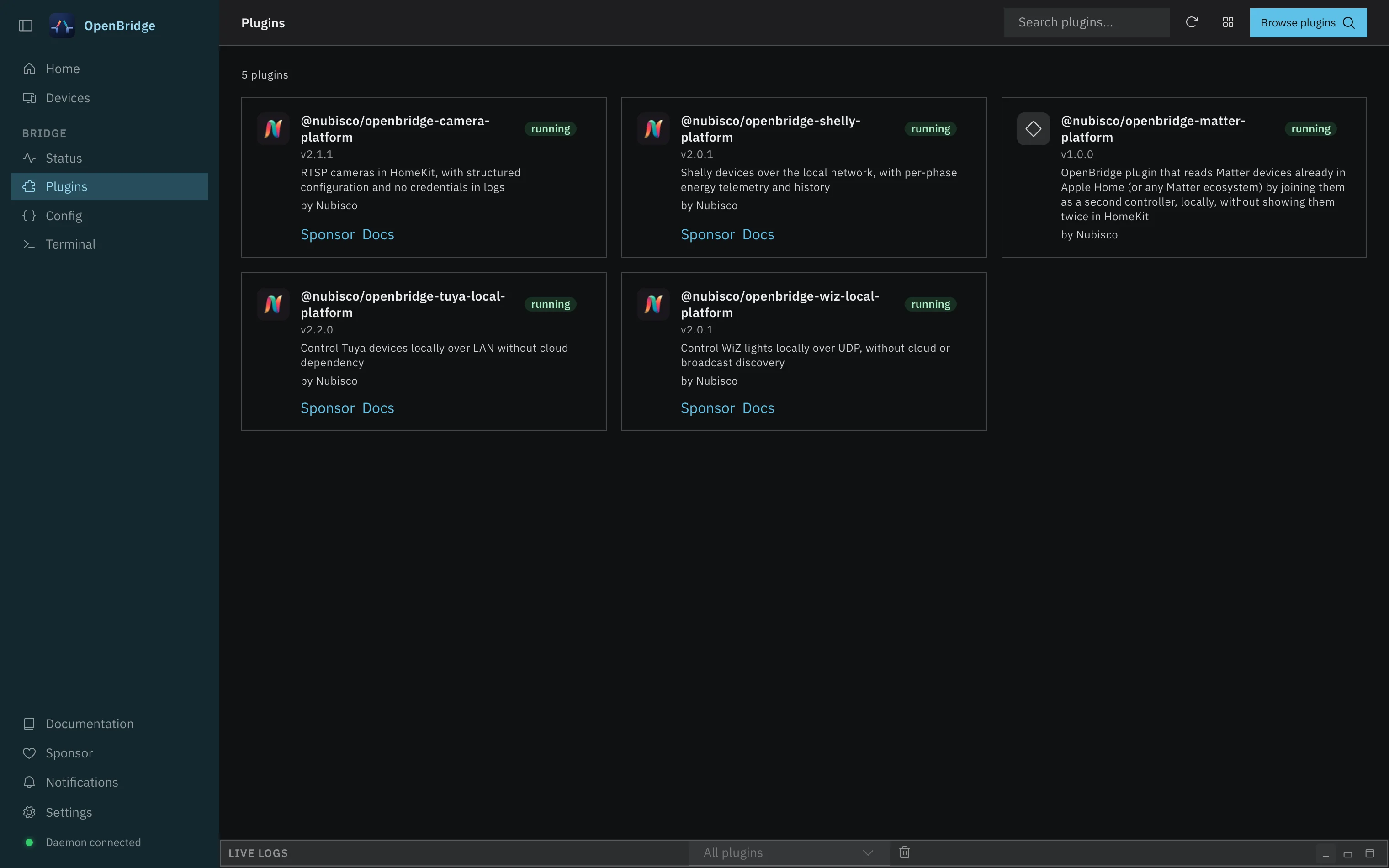
The OpenBridge Plugins page: each plugin with its version, status and source.
The OpenBridge Plugins page.

Plugin Case Study

MappedHeatPumpHeater is the kind of idea this ecosystem should reward

The best part of MappedHeatPumpHeater.accessory.ts is not that it exposes more raw device data. It is that it exposes a better abstraction.

Heat pump devices often think in water temperatures. Humans think in room comfort. The accessory keeps a virtual room target for HomeKit, then maps that target to a water temperature setpoint using a configurable room-to-water table with interpolation.

That means users can aim for a realistic room target, while the plugin translates that intent into device-specific behavior behind the scenes.

An example room-to-water mapping:

  • 18°C room maps to 35°C water
  • 20°C room maps to 40°C water
  • 22°C room maps to 47°C water
  • 24°C room maps to 55°C water

Tuya Plugin Delta

What changed from the Homebridge plugin to the OpenBridge plugin

homebridge-tuya-local-platform

  • Registers as a Homebridge platform plugin.
  • Focuses on device integration and Homebridge lifecycle expectations.
  • Exposes the core Tuya local-control engineering work.

openbridge-tuya-local-platform

  • Supports OpenBridge native plugin mode and compatibility mode.
  • Validates startup config with Zod.
  • Registers telemetry and runtime controls into OpenBridge.
  • Connects the same device layer to a stronger host product.

The invitation to the Homebridge community

OpenBridge is not trying to erase what Homebridge accomplished. It is trying to take the ecosystem one step further: preserve compatibility, improve tooling, expand runtime capability, and remove some of the structural bottlenecks that shape trust and adoption.

If a plugin is useful, users should be able to find it. If a plugin is good, it should be able to earn its reputation publicly. If a runtime can do more for both users and developers, it should.

That is the point of OpenBridge.

OpenBridge is an independent project by Nubisco, not affiliated with or endorsed by Apple or the Homebridge project. Apple, Apple Home and HomeKit are trademarks of Apple Inc., registered in the U.S. and other countries.